


How To Improve Your Aim In Archery
September 17, 2026
Ever watched an arrow hit the bullseye and thought, “How do they do that every time?”
Good aim in archery isn't just about strength or expensive gear—it's about technique, focus, and a few smart adjustments. Whether you're shooting in a local range or preparing for a competition, small changes can make a big difference.
Understand Your Stance
Your stance is the foundation of every shot. If your base isn’t solid, your aim will suffer no matter how steady your hands feel.
Stand with your feet shoulder-width apart, forming a line perpendicular to the target. Keep your weight evenly distributed. Some archers prefer an open stance, turning their lead foot slightly toward the target for better balance and visibility. Experiment to see which feels more natural—you’ll know you’ve got it right when your body feels relaxed but ready.
Perfect Your Grip
Holding the bow too tightly can send your shot veering off course. The bow handle should rest gently against the base of your thumb, with your fingers relaxed and curled lightly around it. This allows the bow to move naturally upon release, preventing torque that can throw off your aim.
A helpful tip: imagine holding a delicate object between your hand and the bow grip—firm enough to keep it in place, but never crushing it.
Focus On Anchor Points
An anchor point is the spot where your hand comes to rest each time you draw the bowstring. It might be the corner of your mouth, your chin, or your cheekbone. The key is consistency. Every shot should have the same anchor point so your aim remains predictable.
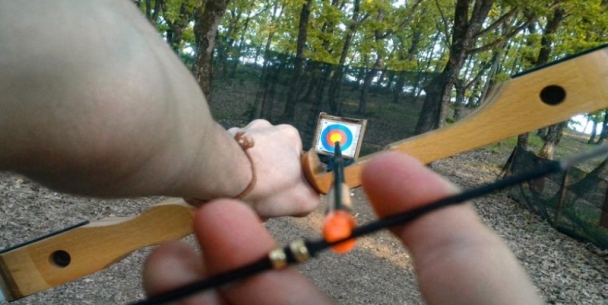
Archers often close one eye to help line up their shot, but you can try keeping both eyes open if it feels more comfortable. Just make sure your head stays still—small movements can shift your aim more than you think.
Mind Your Draw Length
If your draw length is too short or too long, your accuracy will suffer. A proper draw length ensures you’re using your full range of motion without overextending.
Most archery shops can help measure this for you, but as a quick check: when you pull the bowstring, your draw hand should rest at your anchor point without strain, and your bow arm should be slightly bent, not locked.
Use The Right Sight Adjustments
If your bow has a sight, learn how to fine-tune it. Many beginners aim to use instinct alone, but a well-adjusted sight can be a game-changer. Start by shooting a group of arrows, see where they land, and adjust the sight accordingly. Remember, in archery, you move your sight toward where your arrows are hitting, not where you want them to go.
If you shoot without a sight, you’ll rely on instinctive aiming—training your eyes and muscles to work together until hitting the target feels natural.
Control Your Breathing
Breathing might not seem connected to aim, but it is. Many archers find it best to inhale during the draw, exhale slightly as they settle into aim, and release the arrow during a calm pause in their breath. This minimises movement and keeps the shot steady.
Practice With Purpose
Shooting dozens of arrows without a plan won’t improve your aim as much as focused practice. Try drills like:
Shooting at a small target within a short distance, gradually increasing the range.
Practising "blank bale" shooting—firing at a target up close without aiming, to work solely on form and release.
Using a single arrow, walking to retrieve it after each shot, which forces you to slow down and focus.
Strengthen The Right Muscles
Good aim depends on more than just technique—it requires endurance in your back, shoulders, and core. Exercises like resistance band pulls, planks, and rows help build the stability needed to hold steady during a shot. A stronger body means less shake when you’re at full draw.
Train Your Mind
Archery is as much a mental sport as a physical one. Distractions, doubt, and frustration can make your aim waver. Develop a pre-shot routine to keep your focus steady. This might involve checking your stance, Breathing, and anchor point in the same order before every shot.
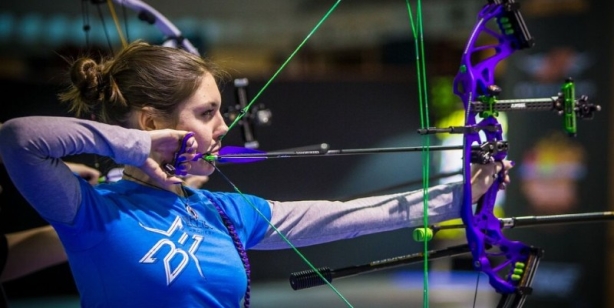
Visualisation can help too—picture the arrow hitting the bullseye before you draw. This primes your mind for success and reduces hesitation. Learn from Your Misses
Every missed shot is a lesson. If your arrows consistently land in the exact wrong spot, it's often a sign of a form issue, not bad luck. Keep notes on what you were doing during those shots—stance, grip, draw, or focus—and make minor adjustments until the pattern improves.
Seek Feedback
Even experienced archers benefit significantly from a second set of eyes. An instructor or fellow archer can easily spot form errors you might not notice, such as leaning forward slightly, locking your bow arm, or unintentionally plucking the string on release.
Recording yourself while shooting can be surprisingly helpful and insightful. Overseeing your form from the side or behind can reveal small habits you didn't realise you had before.
Mix Up Your Practice Conditions
If you only shoot in consistently perfect conditions, you might eventually struggle when the wind suddenly picks up or the light changes dramatically. Practice in different environments—indoors, outdoors, at varying distances, and even with mild unexpected distractions—to make your aim more adaptable.
Respect The Process
Improving your aim in archery isn't about a quick overnight transformation. It's about gradual, steady skill refinement over time. Every minor adjustment made compounds positively over time. Some days you'll hit nearly every shot, others you won't—but each arrow patiently teaches you something valuable.
Getting Better, One Arrow At A Time
Archery rewards patience, consistency, and complete self-awareness. The more you pay close attention to your form, your mind, and your body, the more naturally your arrows will confidently find their mark. With steady practice over time, you'll see your aim steadily sharpen—and that satisfying thud of the arrow in the centre will soon become a sound you hear far more often.