
Cold Plunge, Massage Guns, Compression Boots: 9 Recovery Myths That Are Costing You Money
July 24, 2026
Quick Summary: Recovery gadgets are a billion-dollar industry built on nine very popular half-truths. We separate what genuinely repairs your body from what just feels expensive. Spoiler: one of the best tools costs zero dollars, and one of the most hyped ones may be quietly undercutting your muscle gains. Read before you buy.
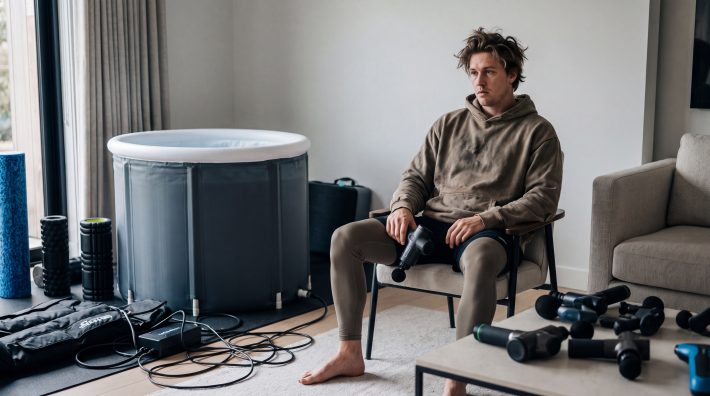
There’s a video making the rounds where a guy screams into a freezing tub at 5:40 a.m. while a voiceover talks about discipline. It has millions of views. In the comments, someone asks whether a $4,500 plunge tub is worth it.
Nobody in that thread mentions that this same guy sleeps five hours a night.
That’s the whole recovery industry in one screenshot. We buy the armor and skip the health potion. Let’s go through the nine claims that cost people the most money.
Myth 1: “Cold plunges make you recover faster and build more muscle.”
Reality: Half right, half backwards.
Cold water immersion genuinely reduces soreness and helps you feel better sooner. Athletes with a game tomorrow use it for exactly that reason.
But research over the past decade has repeatedly suggested that plunging right after strength training can blunt some of the muscle-building signals your body sends after a hard session. The inflammation you’re rushing to kill is partly the construction crew showing up to work.
What to do instead: If your goal is building muscle, wait at least four to six hours after lifting before you plunge, or save the cold for rest days and cardio days.
Myth 2: “A massage gun breaks up scar tissue and lactic acid.”
Reality: It does neither. Not even a little.
Lactic acid clears from your bloodstream within roughly an hour of finishing a workout. It isn’t sitting in your quads three days later causing soreness. And a handheld device is not remodeling scar tissue through skin and fascia — that’s not physically happening.
What it actually does: Percussion massage temporarily reduces the feeling of soreness, increases short-term range of motion, and calms down an over-protective nervous system. That’s genuinely useful. It’s just a different mechanism than the marketing claims.
Verdict: Worth the $99 version. Not worth the $599 version.
Myth 3: “Compression boots flush toxins out of your legs.”
Reality: There are no toxins. There has never been a toxin.
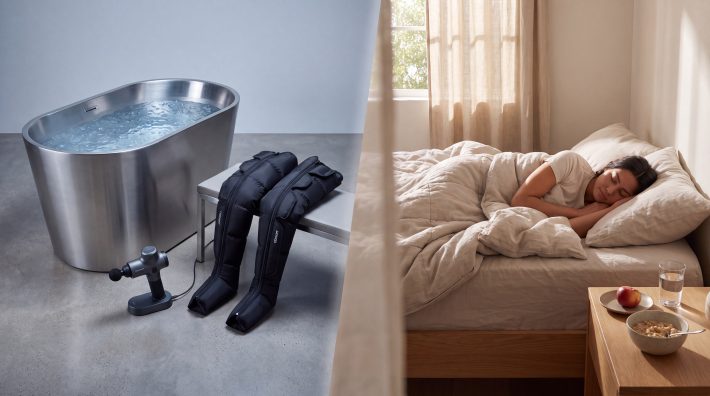
Compression therapy does move fluid, which can reduce swelling and make heavy legs feel lighter — helpful after a long run or a day standing on concrete. It feels fantastic, and feeling fantastic has value.
But a $1,200 set of boots and a $30 pair of compression socks worn overnight produce results that are far closer than the price gap suggests.
Verdict: Great luxury. Terrible necessity.
Myth 4: “Soreness means the workout worked.”
Reality: Soreness mostly means the workout was new.
Try an exercise you’ve never done, and you’ll be sore regardless of whether it was effective. Do a brutally effective session of something you do weekly, and you might feel nothing.
Chasing soreness is like judging a game by how loud the sound effects are.
Better metric: Are your weights, reps, or work capacity going up month over month? That’s progress. Soreness is just noise.
Myth 5: “Stretching before a workout prevents injury.”
Reality: Long static stretching before lifting can temporarily reduce your power output and hasn’t been shown to reliably prevent injuries.
What works: Dynamic warm-ups. Leg swings, arm circles, bodyweight squats, gradually building intensity. Save the long-hold stretching for after, when your tissue is warm and you’re trying to actually improve range of motion.
Myth 6: “You need a protein shake within 30 minutes or the session is wasted.”
Reality: The famous anabolic window is much wider than the supplement industry implied — closer to several hours than thirty minutes.
Your total daily protein matters enormously. The stopwatch does not. Aim for a steady intake spread through the day, and stop panic-chugging in the car.
Myth 7: “Rest days are for people who aren’t serious.”
Reality: Rest days are when the gains happen.
Training is the damage. Rest is the repair. Skipping repair and stacking more damage is how you end up with a nagging shoulder that follows you into your fifties. In game terms, you’re grinding without ever returning to town to fix your armor durability.
Two to three genuine rest days a week is normal, not weak.
Myth 8: “Sleep is important, but I can make it up on the weekend.”
Reality: This is the big one, and it’s the one nobody wants to hear.
Short sleep is associated with worse strength gains, worse fat-loss outcomes, worse appetite regulation, and a higher injury rate. Catch-up sleep helps some, but it does not fully square the debt.
Here’s the uncomfortable math for the drama-app crowd: cutting one hour of scrolling before bed does more for your recovery than every gadget in this article combined. It costs nothing. It’s also the hardest sell in fitness, because gadgets are fun and going to bed is not.
Myth 9: “More recovery tools equal faster recovery.”
Reality: Recovery has a hierarchy, and most people buy from the bottom of it.
Tier S: Sleep, protein, calories, walking. Tier A: Rest days, deload weeks, stress management. Tier B: Mobility work, easy movement on off days. Tier C: Massage guns, compression, cold plunge, sauna.
Tier C is real and it works. It just multiplies whatever Tier S is doing. Multiply a small number by anything and you still get a small number.
The Honest Shopping List
If you have $150 to spend on recovery, here’s the split that outperforms almost any single gadget: a basic percussion massager, a foam roller, blackout curtains, and a decent protein powder. That’s it. That’s the loadout.
If you have $4,500, buy the plunge tub. Just don’t expect it to fix a five-hour sleep schedule, because it won’t, and the tub will know.
Stat callout, no commentary needed: Getting seven-plus hours of sleep instead of five is associated with meaningfully better strength and body-composition outcomes across multiple studies — the kind of difference no $600 device has ever demonstrated. Tonight, put the phone on the charger across the room and see what happens to your Wednesday workout.